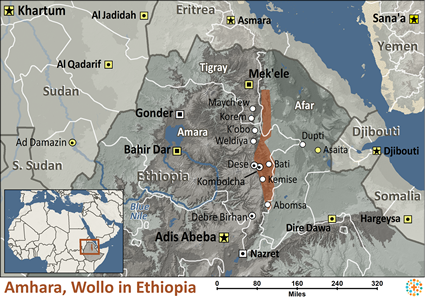

Few regions of Ethiopia carry a more layered identity than Wollo. Situated in the northeastern highlands, the territory now divided into North and South Wollo Zones within the Amhara Region was once known as Bete Amhara — "the House of Amhara" — a name that tells you everything about its historic centrality to Ethiopian civilization. It was here, around Lake Hayq, that Emperor Yekuno Amlak established the Solomonic Dynasty in 1270, claiming descent from the biblical King Solomon and cementing Wollo as the political and spiritual heart of the Amhara world.
The Wollo Amhara are a distinct subgroup of the broader Amhara people, shaped by centuries of interaction with neighboring Oromo, Afar, and Agew communities who settled or passed through the region. This mixing gave the Wollo Amhara a character unlike other Amhara subgroups — particularly in religion. Where much of the Amhara world became and remained deeply Orthodox Christian, Wollo experienced significant Islamization beginning in the sixteenth century, when Muslim merchants and later Oromo migrants transformed the region's spiritual landscape. By the nineteenth century, the Wollo had developed a strong Muslim identity, and tensions with the Christian Ethiopian Empire led to open rebellion. In the 1880s and 1890s, the Wollo united under the leadership of Sheikh Tola Jaafar in an armed struggle against Abyssinian control that continued into the early twentieth century. Though the rebellion ultimately failed, it left a lasting imprint on Wollo identity. In the twenty-first century, political tensions between Wollo groups and the Ethiopian government have periodically resurfaced.
The Wollo Amhara speak Amharic, Ethiopia's national language, which simultaneously marks them as culturally Amhara and gives them wider access to Ethiopian society, education, and Christian resources than many other unreached peoples.
The majority of Wollo Amhara live as subsistence farmers, tending fields in the highlands with tools and methods that have changed little for generations. Oxen pull the plow; seeds are sown and crops harvested by hand; animals thresh the grain underfoot. The primary cooking fuel is dried dung, and very little goes to waste. Injera, a spongy flatbread made from teff — a grain native to Ethiopia — served alongside wot, a deeply spiced sauce of meat or lentils, is the meal that anchors daily life. Coffee, another Ethiopian native crop, is prepared and shared as an act of hospitality that can be as much social ritual as refreshment.
Family life centers on extended kinship networks, with strong obligations to relatives and community. Men handle the fields and animals; women manage the household and bear much of the labor of food preparation. Children contribute early. In the highlands, life is physically demanding — water may be distant, markets far, and famine a recurring threat. A small portion of the Wollo Amhara have moved to urban centers like Dessie, the major city in the region, but the overwhelming majority remain in rural villages.
The Wollo are also known for cultural distinctives that set them apart within the broader Amhara world. The Aholalo festival, celebrated in late January, is a beloved tradition in which young people gather for singing, dancing, and the playful tradition of lime-throwing as a form of courtship. Eskista, a shoulder-rolling dance style, is performed at weddings and celebrations. Women are known for adorning themselves with aromatic plants — particularly weyba — in their hair, a custom strongly identified with Wollo, along with elaborate braiding and butter-dressed hair. Both Muslim and Christian Wollo participate in many of these shared cultural celebrations, reflecting the community's long tradition of interfaith coexistence.
About half of the Wollo Amharas are nominal Christians. The evangelical Christian presence among the Wollo Amhara is extremely limited, and there is an urgent need for faithful witness and gospel-rooted church planting in this community. Islam also has a toehold in their community.
The zar spirit possession cult, found across northern Ethiopia and well documented in Wollo villages, reflects this deeper layer of belief. Zar spirits are understood as powerful entities that can cause illness or affliction, and those who believe themselves possessed seek mediums, rituals, and appeasement ceremonies to find relief. This is not folk custom held at arm's length; it is living faith in spirit forces that people genuinely trust to explain suffering and restore wellbeing.
The Wollo highlands have suffered devastating famines — most notably in the 1970s and 1980s — and the region continues to face food insecurity driven by drought, degraded farmland, and limited irrigation infrastructure. Agricultural development, access to clean water, and healthcare improvements remain pressing physical needs. Many Wollo communities lack adequate roads, schools, and medical facilities, and poverty constrains nearly every dimension of daily life.
Spiritually, the Wollo Amhara need clear and persistent gospel proclamation. They are surrounded by Amharic-language Christian resources, and other Amhara believers who already know Christ are uniquely positioned to cross the cultural and religious distance to reach them. What is needed is faithful, sustained, culturally informed witness — not just literature or broadcasts, but disciples willing to live among the Wollo and point them to Jesus.
Pray for Amhara believers from other subgroups to carry the gospel with love and respect to their Wollo neighbors.
Pray for the traditional power of zar spirit practices to be broken, and for the Wollo to discover freedom and healing in Jesus Christ, the Lord of lords.
Pray for agricultural development workers and healthcare providers to enter Wollo communities as witnesses of Christ's compassion.
Pray that a movement to Christ will take root among the Wollo Amhara and grow rapidly across Ethiopia.
Scripture Prayers for the Amhara, Wollo in Ethiopia.
https://en.wikipedia.org/wiki/Wollo_Province
https://en.wikipedia.org/wiki/Aholalo
https://www.ethiopiaimmigration.org/news/the-unique-blend-of-cultures-in-wollo-ethiopia
https://grokipedia.com/page/North_Wollo_Zone
https://grokipedia.com/page/South_Wollo_Zone
https://www.africaguide.com/culture/tribes/amhara.htm
https://www.researchgate.net/publication/229720337_Group_Therapy_and_Social_Status_in_the_Zar_Cult_of_Ethiopia
https://iiste.org/Journals/index.php/RHSS/article/viewFile/32144/33032
| Profile Source: Joshua Project |